

News
Keith Jones
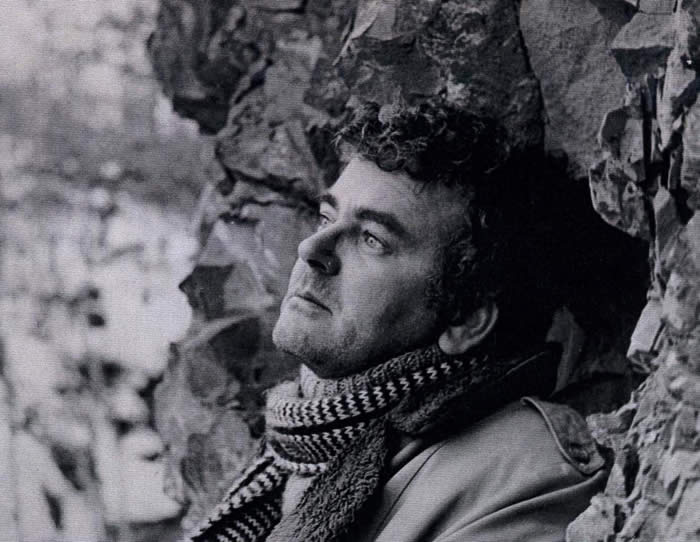
Keith Jones, whose collection, Merrimans, was published by Agenda Editions in 2001, was born in Gwaenysgor, North Wales, and studied at Aberystwyth University. After teaching English for two years in Birmingham, he escaped overseas to Turkey and Ethiopia. He joined the British Council in 1966 and was posted to Alexandria some months before the 6-day war. He worked for the British Council in Nigeria, London, Germany and the Middle East, taking retirement in 1993. Reflected in his poetry are his interests in the Tarot system and Welsh mythology, and his bizarre experiences in the course of his battle to live with Parkinsonism which he fought so bravely.
Agenda Editions hopes to publish more of his work posthumously, and he will be featured in the Welsh issue of Agenda (winter 2008)
.
…perhaps Queen Gaia’s begun some people
culling policy,
perhaps a possible world is passing through
hacking as she goes;
perhaps some swirling saucer took the slice
and now is busy with the DNA,
a small army of your clones even now
entering somewhere parallel universe
where Yeats, constantly summoning lexicographers,
is king of a misspelled world,
and you are his company of knights, come to applaud
the latest verses on Byzantium;
or perhaps just a road, a tree, a fire and reading the flames
a brother of the holy spirit
discourses on how god moved and left behind the swirl,
whrlpool, wheel, whirlwind, womb,
and from it falcon after falcon after jackal
after whatever Thoth deals from the deck.
(from ‘The Ace of Deaths’)
…come forward my dear,
put this blindfold on
in each hand a sword,
now cross them overhead
the moon’s on her back,
the wind’s inside the sea,
the hair rising on our necks.
(from ‘The Two of Deaths)
…it’s time to listen my love, my rival,
to listen rigid to the wailing mothers
they know grief like the swimmer water,
their voices scratch the diamond eye of god,
they are professionals
taking in pain and washing it clean –
whatever the death their breath
can sing afterworlds inside us,
or maps of them and the will to journey,
head down in the Egyptian wind.
(from ‘The Three of Deaths)
…and you recite a self-critique
to each of your judges, all 42 of them, drenched in gossip,
and perhaps
the boatman beckoning
the underground night journey of the sun,
the lake of fire, the faithful serpent in whose coils
the hero hides,
seclusion sweet seclusion like a sleepy sphinx
let me lie here safe from the demands of love,
the plots of rivals,
let’s play the diplomacy of death, rouge the dead lips,
lift the coffin lid, rephrase despatches,
recode the papyrus.
(from ‘The Four of Deaths’)
The above extracts are from Merrimans, Agenda Editions.
A Reconsideration of Rainer Maria Rilke
The special double issue of Agenda, ‘A Reconsideration of Rainer Maria Rilke’ has been referred to by several well-known critics as ‘the best yet’. Dennis O’Driscoll, well-known Irish poet and critic calls it ‘an outstanding issue – the fruit of hard and loving labour. It will serve as a permanent resource – a one-volume treasury – for Rilke readers, new and old’. Poet Brendan Kennelly calls it a ‘splendid, epic tribute to, and celebration of Rilke and his work.’ He continues: ‘It’s like a choir at its most magnificent…There’s something truly beautiful about the choir of poets paying tribute to Rilke’s unique spirit… Readers will love this issue of Agenda more as the years slip by.’
Its arresting cover is a fitting and charming woodcut by Caroline Trant (email: [email protected] ). The varied and carefully chosen 288 pages contain an organised mixture of new translations/versions by mainly well-known translators and version-makers, with some new voices; highly interesting essays on Rilke, all of which take an original angle; a section of general poems to, on or for Rilke also by new and well-established poets; and translations of essays in French on Rilke.
Young poets continue to be encouraged and two very gifted chosen young Broadsheet poets, Adam O’Riordan and Zoe Brigley are highlighted here for prominence. Other fine young poets and artists feature in the accompanying online Broadsheet (No. 8 in the series) on this site.
AGENDA Editions Launches in Ireland
John Montague and Prix Goncourt prizewinner (the first ever Prix Goncourt to be given for poetry rather than prose) Claude Esteban gave a dynamic reading of their joint venture published by Agenda Editions in Dun Laoghaire at the Poetry Festival there in May. Copies (£7.99 each) of A Smile Between The Stones can be ordered from Agenda Editions, The Wheelwrights, Fletching Street, Mayfield, East Sussex TN20 6TL.
Desmond O’Grady‘s Kurdish Poems of Love and Liberty (£9.99 each) were launched in Dingle, Co Kerry, in the exotic atmosphere of the Club Havana run by Tim and his charming wife at the Poetry Festival there run by Micheal Fanning in June 2005. Patricia McCarthy, editor of Agenda Editions, and Desmond read his moving poems alternately and then in a duet.
Another launch of Desmond O’Grady‘s book took place in Bandon, Co. Cork, kindly sponsored by Matthew Geden, a great supporter of Agenda and an Agenda poet from Kinsale, and his bookshop.
Notes for Broadsheet Poets
Continuing online is the series for poets and teachers alike of Notes for Broadsheet Poets (also printed in the magazine). This time, these Notes consist mainly of wise, highly articulate and profound excerpts chosen from the ‘Poet’s Journal’ of the well-known Irish poet and verse-dramatist, Pádraic Fallon . Dip into these to be inspired, entertained, intellectually challenged and impressed.
What to watch for:.
A write-up on the latest issue of Agenda in The Arts & Books pages of the Independent on Friday, July 28th, 2006
On Sunday, July 9th, 2006, June English’s poem, ‘Family Day, June 1967’ which is printed on page 14 of the latest issue of Agenda will be the chosen poem in the Independent on Sunday.
The new online supplement to the Poems on Water in the issue consists of further beautifully executed poems (and translations) focusing on water from many different angles. There was no further space in the issue for these fine poems, and some unfortunately arrived too late, but the web is equally prized and gives considerable exposure, which, it is hoped, reverberates back to the magazine. Poems on Water in the online supplement are by: David Betteridge, Mark Leech who has translated Frederico Garcia Lorca and Andres Sabella, Julian Farmer who has translated Anna Akhmatova, Nigel McLoughlin with two of his own poems and a translation from the Irish of Máirtín Ó Díreáin, Davina Prince, Sean Elliott, Graham Burchell, Byron Beynon, Joseph Horgan and Catherine Mazodier who entwines the two languages of French and English.
New highlighted translations in the online Translation section include: Güven Turan translated from the Turkish by Ruth Christie, Samaine Bouinou translated from the French by Fred Johnston, Hervé Chesnais translated from the French by Fred Johnston, Carlos Pezoa Veltz translated from the Spanish by Mark Leech, Jorge Teiller translated from the Spanish by Mark Leech, Andres Sabella translated from the Spanish by Mark Leech, Anna Akhmatova translated from the Russian by Julian Farmer, Montale translated by Tom Day, Catherine Mezodier who entwines English and French, Seán Ó’Ríordáin translated from the Irish by Greg Delanty.
Please see general interest essays with young essayist Julia Forster whose subject is ‘Critical Openness: A Study of Poetry in Public Places‘.
Death of Claude Esteban
We have received the sad news of the death of Claude Esteban, the first ever poet, rather than a novelist, to win the Prix Goncourt for Poetry. The Irish poet, John Montague, translated a sequence of Esteban’s loosely based on King Lear: A Smile Between the Stones (Sur La Dernière Lande), and this was published by Agenda Editions with a grant from the Arts Council of Ireland in 2005. Copies (£7.99) each are available from The Wheelwrights, Fletching Street, Mayfield, East Sussex TN20 6TL.
John Montague sent the following poem as an epitaph for his friend, Claude Esteban: From SOMEONE BEGINS TO SPEAK IN A ROOM
When one has suffered too long, one should
pause sometimes, and laugh a little, and share
with friends some sweet cake since one is drinking
sweet wine from the Canaries and let there be dances
even a shade wanton, so once spoke a fool
to distract his master who did not mend
or who did not wish to mend from his malady,
I know others like that.
Bandon Books
Bandon Books in County Cork are delighted to be the main distributor in Ireland for Agenda and Agenda Editions. Back copies of Agenda are in stock, as are new collections from Agenda Editions by John Montague (translating Claude Esteban) (£7.99) and Desmond O’Grady’s Kurdish Poems (£9.99), both funded generously by the Arts Council of Ireland.
For further details and orders, please contact Matthew Geden, Bandon Books, Howard Court, Bandon, Co. Cork, Ireland. E-mail [email protected] Tel: 00353 (0)2354791.
The Whereabouts of Yevgeny Yevtushenko
In the ’60s and ’70s, the name Yevgeny Yevtushenko was on everyone’s lips as the daring young rebel who broke the Iron Curtain and wrote freshly and fearlessly as an important voice of the new, post Stalin generation, pushing ‘frontiers’ out of his way, as the spokesman for an age. However, as he admitted in the conversation below, he felt he was created by the West as a rebel against Communism, because the West liked this, in their desire to see all Communists as devils, though some were obviously idealists. Not so much is heard of Yevgeny Yevtushenko nowadays in the West, but he is very much alive and prolific, still providing consummate performances of his poetry, a veritable Hamlet onstage and wearing his seventy plus years very well – such as in Listowel Writers’ Week, County Kerry, and in Dingle, County Kerry in June 2005.
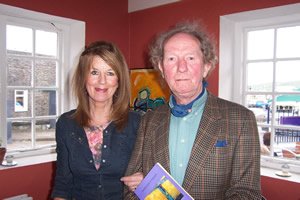
Patricia McCarthy, editor of Agenda, was in Dingle to launch Desmond O’Grady’s Kurdish Poems of Love and Liberty, (£7.99), published recently by Agenda Editions, with a generous grant from the Arts Council of Ireland
Over lunch in a well-known fish restaurant with Yevtushenko, his son and Michael Fanning, the Irish Medical Doctor poet, a native of Dingle, Yevtushenko revealed a lot about his life, his poetry, and the novels on which he is now concentrating.
He recalled, in his childhood, hearing old folk rhymes from older women and from widows when the men were on the front and the teenage Yevtushenko and his peers were the only males in the village. He said: ‘Rhymes help remember poetry’. Explaining in Russian, by handwritten scribbles in Patricia McCarthy’s Irish ‘copy book’ purchased in the local supermarket, he demonstrated his innovations in folk rhymes which afforded space for freedom for the first time.
In his introduction to the big anthology, Twentieth Century Russian Poetry, Selected and with an Introduction by Yevgeny Yevtushenko, (Fourth Estate, London 1993), he claims that ‘a poet in Russia is more than a poet.’ However, though known in the West more for ‘political’ poetry than his love poetry, for releasing ‘the secret freedom’ sacred to the poet that the dogmatists could not tolerate, he does not wish to be interpreted just as an accessible political poet. To be sure, he worked for newspapers when young and his famous anti-semitic poem, ‘Babii Yar’, caused a stir. It ‘broke the conspiracy of silence’, was on the front pages of the most powerful newspapers internationally, in Time, Le Monde, for example, and he received over one thousand telegrams about it. It was from this point that people began to translate him and to make him known in the West. He admires Pasternak, for example, for his inaccessible, complicated poetry and, unlike the latter, Yevgeny can be recalled saying disarmingly in the 1990s: ‘My guilt is my simplicity – / My crime is my clarity’ and, at another time: ‘I am just the ragtag voice of all the voiceless’, though in ‘Prologue’ (1955), he did talk of some sacrifice: ‘What if art be my torment?’ – even if this sacrifice included giving up the idea of becoming a professional footballer. He was, he insisted, famous first in Russia as a love poet, and, to him, ‘life is a mixture of politics, love, frustration, philosophy’. What he has always aimed at doing is to ‘make a portrait of all the ingredients of life’. He writes, he said, out of tenderness and out of shame. And it is this ‘shame’, he explained, that all political poems come from.
In talking about his public performances, he said his aim is to try to transform listeners into readers. He recites always as a ventriloquist, and can feel the voice of his father when performing his poems. He was influenced by songs of the Second World War, and by the crowds that gave him no fear of people en masse. The essential thing, he insisted, is what some actors miss: the importance of combining content and music. ‘We have to be grateful to Yeats on behalf of all poets’ for this. Indeed, the first criteria he uses for choosing a poem are emotions and music, secondly thoughts and thirdly philosophy. He likes all styles of poetry expects a poem to have many ingredients, just like the forty ingredients he uses in the Borsch he makes.
He said that he feels young poets need some kind of spiritual renaissance. There has been enough mockery, sarcasm and cynicism, often coupled with irony. But it is essential to have a little ingredient of romanticism and idealism for a poet to survive. This links to his youthful wish for ‘Ministers of Tenderness and Truth’, a wish he later abandoned, having seen how many egotistical poets were at each other’s throats. He defines ‘good poetry’ as a confession of oneself, yet, as seen above, he knows the danger of a poet falling into narcissism. All in all, he concludes: ‘Young poets don’t try to lift big enough boulders.’
Yevgeny has had many famous friends from all disciplines of art: Picasso, Eliot, Fellini, Shostakovich (who wrote a symphony inspired by his poem ‘Babii Yar’) and he feels that all the arts stem from the one root, have the same source and should be interlinked as in Paris of the 30s, 40s and 50s.
Nowadays, in the post Glasnost age, he discussed his predilection for writing novels, vindicated, perhaps, by John Steinbeck who said he could predict that, in the twenty first century, Yevgeny, while being highly regarded as a very good poet, would become more famous as a novelist. Steinbeck called him a great storyteller, the only man on earth who knows both sides of a divided world, who knows the Russian peasants, and the intellectuals. (Yevtushenko has described himself as being ‘half peasant’ and half intellectual’. He was brought up in Siberia where many were packed off to). In his recent novel he has combined autobiography with fiction in a most innovative way.
It is apparent, even when conversing with Yevgeny, that he like stories/narratives and ballads. He calls himself a pupil of Kipling whom he sees as having reflected reality in the days of colonialism. A poet he admires greatly is the American Walt Whitman, while novelists who are his mentors include: Mikhail Bulgakov (The Master and Margarita), Romain Gary (The Promise), William Golding (The Spire), Patrick Susskind, and Gabriel Garcia Marquez.
One wonders if Yevgeny has yet shown all his ‘faces behind the face’, and also if his own prediction will come true. In ancient Russia, tongues were cut out of living poets and buried. Yevgeny predicts: ‘A time will come when the harvest of severed tongues will reach the clouds’. Let us hope so.
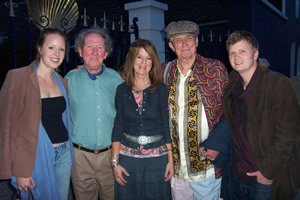
Left to right, Sasha‘s girlfriend, Libby; Desmond O’Grady; Patricia McCarthy, editor of Agenda; Yevgeny Yevtushenko, and Sasha, his son. Dingle, County Kerry, Ireland, June 2005.
Celebrating Independence of St Lucia
 Maria Cristina Fumagalli, guest editor of the Derek Walcott issue of Agenda at the Festival Hall, where Walcott appeared to celebrate the Independence of St. Lucia.
 He signed copies of the Special issue which contains, among many other poems and essays, a long canto previously unpublished, written by Walcott when he was only eighteen. (Photograph by Sue Fallon)