The latest issue of Agenda, Vol. 42 No.1, with a special focus on Poems on Water, came out in June, 2006. Also included is a long poem by John Fuller. Incisive essays at the cutting edge of poetry are by such notable critics as Martin Dodsworth and William Bedford.
Michael Kinsella is the chosen young Broadsheet essayist. The two Broadsheet poets highlighted in the issue are Sinead Wilson, 31, and Ailie MacDonald, 18, whose work shows a surprising maturity.
Agenda’s continual encouragement of young poets and essayists is further demonstrated, as always, by the accompaniment of a very lively, colourful online Broadsheet 6. This contains work by 16 ‘young’ poets: Tom Bedford (17), Ross Cogan (35), Sarah Hesketh (22), Carley Moulton (22), P.T. Abbott (19), Anne- Louise Kershaw (26), Lisa D’Onofrio (34), Shivani Sivagurunathan (24), Jessica Harkins (32), Peter Upham (36), Lawrence Bradby (36), Anthony Trevelyan (32), P. Viktor (27), Natalie Ford (30), Naomi Foyle (38), Tupa Snyder (30).
Launch of Agenda Editions’ No Dammed Tears by Jan Farquharson (£8.99) at The Irish Centre, Camden Town, January 7th, 2006. This event was held at 2.30pm in the Ballroom and was very well attended, with poets, friends and relations of Jan Farquharson, his widow, Barbara Farquharson and John Torrance, childhood friend, fellow poet and Literary Executor of his estate. John Torrance acted as compere, and Patricia McCarthy introduced the occasion as editor and publisher of the moving, powerful sonnets.
Sarah Hopkins, poet and assistant editor of Tears In The Fence and Oliver Bernard, translator of Rimbaud’s Collected Poems (Penguin) and of an Appolinaire selection (originally published by Penguin and now published in a revised edition by Anvil Press). (Available from The Wheelwrights, Fletching Street, Mayfield, East Sussex TN20 6TL)
An enjoyable evening was had to celebrate Agenda and its Irish links with Agenda poets on 20th October 2005. Even by Irish standards, there was a terrible deluge in which Noah himself would have complained and everyone arrived soaking wet. However, the space was good, the lighting inviting and the poets read very well.
Among others present were: Macdara Woods and Eilean Ni Chuileanáin who had come down from Dublin (editors of Cyphers and both well known poets), Adam Wyeth (who has made a very fine film of Desmond O’Grady – bites of it to be shown later on this website), Thomas McCarthy, Robert Chandler, Paddy Bushe. Agenda greatly appreciated the generous hosts from Tigh Fili.
About 60 people, including poets, editors and academics, attended a very successful launch of Agenda‘s double Australian issue, kindly hosted by the Menzies Centre for Australian Studies, Kings College, London, 28 Russell Square.
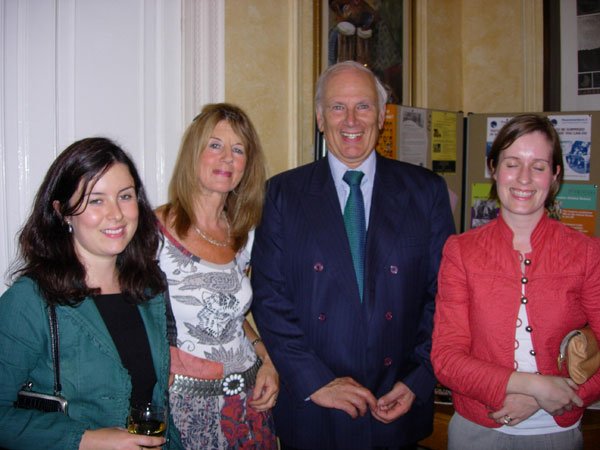
From left to right: Merryn Andrews, neice of the Editor; Patricia McCarthy, Editor of Agenda; H.E. the Hon. Richard Alston, High Commissioner for Australia and Anna Nieuwenhuysen; Cultural Advisor to the High Commission.
Dr. Ian Henderson warmly greeted everyone, including H.E. the Hon.Richard Alston, High Commissioner for Australia, and the Cultural Advisor, Anna Nieuwenhuysen. Patricia McCarthy then introduced the exciting issue which, she said, proved that Australia is a vital, unique and highly energetic force in its own right. She quoted the Australian poet, Judith Wright, matriarch of modern Australian poetry who wrote:
When all the living’s done
it’s poems that remain.
She said that the poems had been chosen not because they were specifically ‘Australian’. Though many are deeply rooted in locality, they transcend time, place and nation and give that extraordinary shiver down the spine, standing as impressive international works in the English language.
In Agenda‘s long publishing history of international issues (along with Special issues and general anthology issues), she commented that there had never been an Australian issue. Scripsi (a highly regarded Australian poetry journal no longer in print) had invited Agendato supply a whole section for one of their issues in 1987, and, of course a few individual Australian poets had appeared over the years in Agenda ‘s pages. She quoted poet John Kinsella (described by Martin Dodsworth in this issue as a ‘genius’) who said: ‘A literary journal culture is integral to the vitality of poetry and language itself. Literary journals are the crucibles of the word.’
She hoped, then, that this Australian issue would indeed be a ‘crucible of the word’ for poets and readers alike, introducing, through both poems and essays, voices bound to echo importantly in the future. That has always been what Agenda is about, she explained: discovering and promoting important, authentic voices and, as in this issue, giving space to long poems when they deserve it. A newer concern of Agenda, initiated by her, is the promotion of young poets via the online Broadsheets, with one or occasionally two chosen poets given wider coverage in each issue of the magazine. Two young Australian poets had been chosen for this issue: Petra White, born in Adelaide in 1975 and living in Melbourne, and Joanna Preston, a thirty two year old expatriate Australian currently living in West Yorkshire and studying for an M Phil degree at the University of Glamorgan.
Patricia McCarthy referred to the poet Barry Hill‘s prizewinning biography: Broken Song: T.G.H. Strehlow and Aboriginal Possession (Vintage, 2003) in which Strehlow was quoted as saying of the Aboriginal Songs: ‘ “If everything is vitally interconnected, then the whole world is a poem, an enchantment simply awaiting notation, or indication”.’ She suggested that the poems in the pages of the issue encourage the thought that the whole world is, indeed, ‘an enchantment’.
Clive James then gave an entertaining homily, talking about the making and the publishing of poetry, about his own poetry and reading a highly evocative poem on his own childhood.
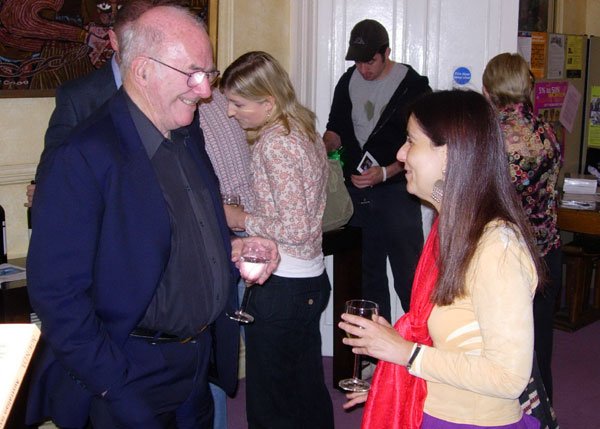
Clive James talking with Maria Cristina Fumagalli at the Launch.
The Australian contributors who had managed to be in attendance read first: David Brooks who read a very moving elegy and love poem, leaving readers to treasure those poems of his actually in the issue; Katherine Gallagher who read three of her four fine poems from the issue, ‘Entente‘, ‘Graffitist‘ and ‘Hybrid‘; Sandra Hill who also read her two poems from the issue, ‘Intersection‘ and ‘A Melbourne Autumn‘, and Clive James who chose to read two poems other than his ‘Literary Lunch‘ in the issue. A surprise reader was Philip Neilson who read his poem ‘Crusoe Revisited‘. It had arrived too late to be included in the issue but will appear on the website. Peter Porter unfortunately had had to cancel his reading the day before because of family matters, Alison Croggon had been unable to change her plane ticket and so missed the launch, sadly, by two days, and Barry Hill, likewise, had intended to come but had been unable to change his ticket.
Katherine Gallagher and Sandra Hill who read their poems from the issue.
Steven O’Brien, an Agenda poet of Irish descent discovered by Patricia McCarthy whose first collection Agenda Editions will publish, Michael Venditozzi whose first poems also appeared in Agenda, and who has kindly agreed to help running the Agenda website, Patricia McCarthy and Colin Wilcockson, the well-known medievalist and poet from Pembroke College, Cambridge, a new trustee of Agenda, all read chosen poems from the issue to air voices of Australian poets who could not be there.
The occasion was rounded off by the resonant voice of Steven O’Brien who sings, like his father and grandfather before him, in both English and Irish in pubs in England and Ireland. His powerful, unaccompanied rendition of the an Australian ballad ‘Ben Hall’, prefaced by a fascinating personal anecdote, received much applause.
Patricia McCarthy and new trustee of Agenda, Colin Wilcockson, Medievalist and poet from Pembroke College, Cambridge.