Stepping Stones editorial and introduction: John Burnside

Almost thirty years ago, William Cookson invited me to take part in a reading for Agenda at The Tricycle Theatre, in London – an invitation that, I confess, came as something of a surprise. At that time, I was very much a literary outsider: I worked full time in the computer industry, designing knowledge-based systems; I lived in an extremely sleepy suburb just outside Guildford; my usual reason for going into the city was to interview clients, mostly underwriters from the larger insurance firms. True, I had published a couple of proverbially slim volumes with Secker and Warburg, but I had taken part in very few readings and I knew almost nobody on what some people, even then, were calling ‘the poetry scene.’ Nevertheless, flattered (and because it was William) I agreed to go – and, naïve as I was, I did so without even asking who the other participants might be.

The day of the reading came: Shakespeare’s birthday, 1994. A Sunday, as it happened, which meant an early departure for work the next morning. As the train pulled in to Waterloo, I started to get nervous. I was a terrible reader, everybody said so. I was a computer nerd, happiest when solitary, and in most situations, socially awkward. If I had a natural habitat, it was in the broad- leafed woodland around my home village, or my canal-side garden plot… By the time I reached the theatre, this vague anxiety had grown to simmering point – and then I walked into the auditorium and discovered who, exactly, I would be reading with. Stephen Spender. Harold Pinter. James Fenton. The list goes on. Christopher Logue. Hugo Williams. Anne Beresford. For a long moment, I seriously considered making a run for it.

Now, looking back, I am deeply grateful for the lessons of that evening. When I got back to Bramley, that night, I was no less of an outsider but, even though the conversations I managed over the course of the evening, both with fellow readers and with audience members, were halting and desultory (on my part, at least), I was coming home with a sense that, somewhere in the capital, there was a loose community of people for whom poetry was a vital art – not just the poetry they or their friends wrote, but all poetry. Old poetry, new poetry, poetry in translation. For me, this latter point made all the difference: still an apprentice in verse, I had learned what little I knew of poetry’s music from French and Spanish poets, in the main, as well as from inspired translations of many poets I could not read in the original, from Rilke and Celan to Anna Akhmatova and Osip Mandelstam. It may sound naïve, now, but that evening illuminated my sense of what was happening, not on the much-discussed ‘scene’, but in the poetry world.

Poetry is, or ought to be, the broadest of churches, but it also depends and subsists on certain key qualities that, for me, have always been at the centre of Agenda’s philosophy. First, that it is the nature of poetry to be musical, to find ‘song’s truth’ in its diverse forms; second, that poetry prospers by exchange, by dialogue and, most of all, by listening to the music of others and of the world itself; third, that it is not unrealistic to stake the claim, with Hannah Arendt, that ‘metaphors are the means by which the oneness of the world is poetically brought about’– and, in my view, Agenda has always been attuned to this sense of poetry’s possibilities.

Now, with all these things in mind, I am both honoured by, and all too aware of the responsibilities entailed in, my stepping into an editorial role that has been so conscientiously and elegantly upheld over six plus decades by, first, William Cookson and, more recently, Patricia McCarthy. Over the years, Agenda has consistently fulfilled a combined remit that few other quarterly magazines would seriously contemplate, introducing the work of exciting new poets, while offering in-depth critical insights into the work of significant international writers and inviting established poets into convivial and insightful discussions and interviews. It is my aim to continue in this same vein, not just by drawing on my own associations and shared ambitions for poetry that have built up over many years of reading, listening to and simply being curious about other poets, poetry curators and critics, but also by seeking out the work of new writers, for whom the crafting of poetry – its unique philosophical power (what the great Spanish philosopher- poet Maria Zambrano called la razón poética); its ability to sing in all the ways that song can happen; its full, and often dissident, engagement with preserving and revitalising language – is a central concern. Going forward, I hope that the Agenda of the future can live up to this established tradition of advocating for, and celebrating poetry for its own sake: for what it can do, for what it dares and, just as importantly, for what it refuses to concede.
Stepping Stones editorial and introduction: Patricia McCarthy

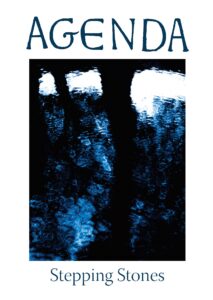
Stepping Stones coverStepping Stones back cover.

Firstly I would like to wish all subscribers, contributors and readers as happy, healthy and creative a New Year as possible in these troubled times. This issue marks a turning point for Fred (admin) and myself who have, with great pride and honour, run this journal for more than two decades, as Seamus Heaney said ‘upholding the lofty standards of Agenda’ which were, of course, established by the remarkable founding editor, William Cookson. However, it is with great excitement and enthusiasm (tinged of course with a little sadness) to announce that Agenda is being taken over by the University of St Andrews, with the illustrious poet and Professor John Burnside as the new editor. Agenda will be in excellent, creative, energetic and safe hands and John intends to keep intact the ethos of the journal which, it has been said ‘does what no other poetry journal does’.

Magic comings-together have often happened, for example, with issues of Agenda and this crossover also seems to have that magical ingredient; therefore it seems meant to be that John Burnside takes the helm. I hope I can be forgiven for adding a little autobiographical information here to explain this.

Many years ago, having lived abroad in Bangladesh, Nepal, Paris and Washington DC with my first husband, in my youth, I sent poems off to Agenda and had the good fortune to be adopted as an ‘Agenda Poet’ when William Cookson and Peter Dale were joint editors. When I returned to England, I would meet up on many Friday evenings with William, Peter, Sam Milne, Roland John and a few others. I met up with Michael Alexander several times, with Kathleen Raine for tea also, and, of course had many lunches with Grey Gowrie, a tremendous long-standing supporter and guardian of Agenda. I hardly ever attended poetry readings but I did go to one – I think in a dark little cellar somewhere in Brighton and heard the most wonderful, natural-sounding poems breathed out by the then almost unknown John Burnside. I immediately reported to William how utterly impressed I was by his reading, so William read his poems and made sure he got in touch with John, inviting him to read with poetry worthies in London (John refers to this in his introduction) – after which John’s illustrious standing as a leading poet became deservedly established.

It seems more than fitting, therefore, in terms of circles and patterns, that John now inherits Agenda. He, and his team at the University, will inject it with greater energy, inspiration and expansion. Fred (who is really a farmer and comes from Sussex farming stock way back, but who has a natural affinity with poetry, and editorial skills) and I have been a ‘team’ of only two and the task of running the whole thing does become somewhat draining, especially with no funding, or very little. Other journals have teams of specialists who, separately, undertake, for example, subscriptions, submissions, publicity, advertisements, manage reviews, organise readings and launches etc. and John will be backed up by a whole team of qualified helpers which will enhance further Agenda’s reputation in this demanding world of social media. William never used computers, cycled to the typesetter who spoke very little English on his butcher’s bike with hand- written poems tucked inside a dog-eared folder – and how very well he did with just this. However, it is a different world now with a barrage of submissions coming in via email and huge demands from the Arts Council (when we did have the funding).

In our time, since William died in January 2003, and Agenda suddenly fell to me (I had been co-editing it with William for about five years while teaching), we have obviously had to computerise the journal, and I have made innovations such as encouraging the publication of more women poets, as Agenda was originally quite a male bastion. I have also established young Broadsheet poets, one or two chosen ones to be highlighted in the journal and other talented ones showcased online, along with young artists. Accompanying the Broadsheet poets series, is another ‘Notes for Broadsheet Poets’ series for budding poets and their mentors. This is in print and online. I have had a special interest too (being half Irish and brought up in the Republic) to bring into focus gifted Irish poets both known and unknown. William Cookson had Scottish blood in his genes and he, similarly, encouraged Scottish poets such as W S Graham and Hugh MacDiarmid, amongst others. This is another reason it seems fitting for Agenda to have a Scottish (hence Celtic) flavour at times with its new residence in St Andrews. Of course, international issues have, at the same time, always been important to Agenda and John will continue to promote poems from around the world, with his wide contacts.

I would like to thank, firstly, the present trustees (of which I am one) for their generous support: Timothy Adès, translator/poet and W S (Sam) Milne, poet/dramatist, who have presided in the wake of earlier trustees Harold Pinter, John Bayley and Edmund Gray, grandson of Laurence Binyon.

Timothy and his wife, Dawn, very generously hosted Agenda’s 60th birthday celebration a few years ago in The Art Workers’ Guild in Bloomsbury. This has a special connection with David Jones who did by hand Agenda’s logo. Sam has been a regular reviewer, plus a proof-reader with me when we check – over the phone – the dot and dash of each page of Agenda from our separate proofs.

Immediate and special thanks also go to Jane Bromham and Carole Cornish of JAC design for their role in typesetting and printing, and with whom we have worked most compatibly over the years.

Final thanks go to all the readers, subscribers and contributors over the years and we are sure you will continue to enjoy Agenda as it crosses over into, not a new era, but an extended one, retaining its maverick character.

I have made many new friends through Agenda, even if only online, and I do hope we will keep in touch.
Very best wishes go to John Burnside and the University of St Andrews who will continue to promote, as David Jones put it, ‘carpenters of song’.